The usual line is that a non-CLI route is the same call at a lower price, with a cosmetic difference in what the screen shows. I’ve watched that belief cost outbound teams more than the route ever saved them.
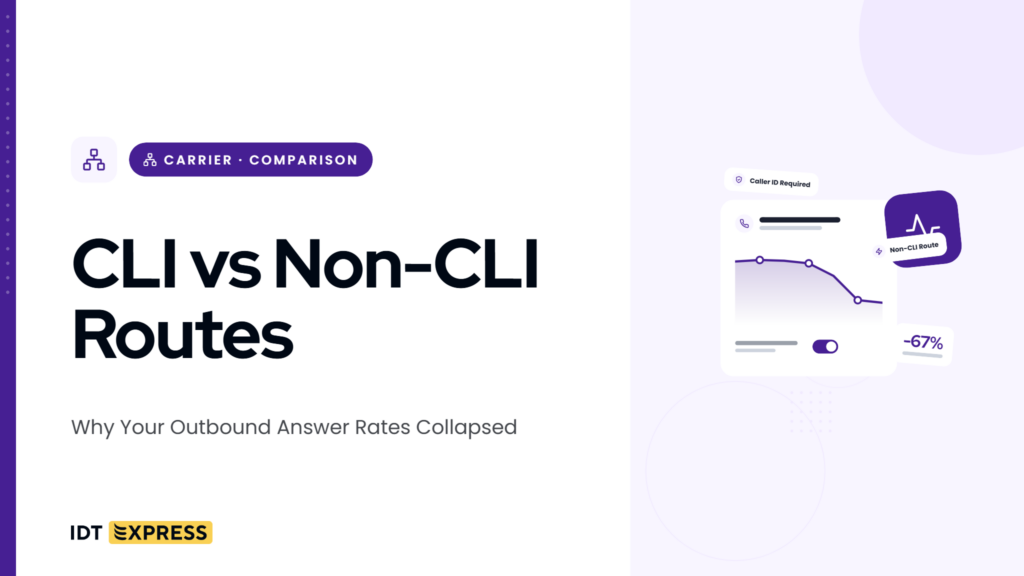
A CLI route delivers the caller’s number, the calling line identity, unchanged to the person being called. A non-CLI route makes no such promise: your number may arrive intact, arrive as “private,” arrive in a broken format, or be replaced with some unrelated number from another country. The audio path can be identical. What differs is whether the person holding the phone has any reason to answer it.
For an offshore BPO calling UK or US consumers, that difference is the business.
The myth: “It’s just the caller ID”
Caller ID isn’t decoration. On a mobile handset in 2026, it’s the main input to one decision: answer or ignore.
Consider what the recipient sees. A local number or a number they recognize: plausible call, maybe answer. “No caller ID”: ignored by a large share of people on principle. A random number from a country they’ve never called: ignored, and sometimes reported. Your agents sit waiting while the dialer burns through a list that never picks up.
Then there’s the second-order loss. When someone misses a call from a real number, some of them call back. That callback lands in your inbound queue and is often the warmest contact of the day. When the displayed number was a random substitute, the callback goes to a stranger or to nowhere. You don’t just lose the call. You lose the second chance.
None of this shows up in a rate comparison. It shows up weeks later as a campaign that “underperformed.”
What happens to your CLI on a non-CLI route
On a non-CLI route, somewhere between your switch and the handset, the calling number stops being your decision.
Wholesale voice often passes through several carriers before it terminates. Each hop has its own policy on the calling number. On a clean path, every carrier passes it through. On a cheaper path, one of them may not, for reasons that are commercial rather than technical:
Bypass termination. Some low-cost routes terminate international calls as if they were local, by pushing them through SIM boxes or other gateways that inject the call into the mobile network with a local SIM. The call gets cheaper because it avoids the international termination rate. The recipient sees the SIM’s number, not yours. Operators and regulators in many countries treat this as fraud and actively hunt for it, which also means the route can vanish overnight.
Over-the-top diversion. Some paths divert calls onto app-based calling at the far end. The call may ring inside a messaging app instead of the phone dialer, with whatever identity that app displays.
Stripping. A transit carrier may simply drop the CLI or mark it withheld, often because the next hop won’t accept international CLIs or because nobody configured it to pass them.
Regulatory blocking. Some regulators now require operators to block or strip international calls presenting domestic numbers, to fight spoofing. That’s a good policy with a specific consequence: if you present a UK or Indian number on a call entering from abroad, it may never ring. The details differ by country, which is why corridor-specific planning matters, as we cover in our guide to country playbooks for voice termination.
The common thread is that “non-CLI” is not a feature. It’s the absence of a guarantee, and the absence gets filled by whatever is cheapest for the carriers in the chain.
Why the numbers look fine until they don’t
Non-CLI traffic is hard to diagnose because the metrics you watch first mostly look healthy.
Calls still connect. Post-dial delay may be fine. What drops is the answer-seizure ratio, and ASR also drops for a dozen other reasons: bad list quality, calling at dinner time, a holiday in the destination. So teams blame the data vendor, then the script, then the time slot, and only at the end check what number the recipient actually saw.
If you’ve got falling ASR on one destination with stable network effectiveness (calls reach a ringing phone, people just aren’t answering), CLI is the first thing to check, not the last. Our walkthrough on reading ASR, ACD and PDD together shows how to separate “the route is failing” from “people are declining.”
When non-CLI is the right choice
Here’s where I’ll disagree with the other half of the industry. Non-CLI routes aren’t always wrong.
There’s traffic where the recipient’s answer decision doesn’t depend on the displayed number, or where the number displayed doesn’t matter to the outcome:
- Pre-arranged calls. A scheduled callback where the recipient is waiting for the phone to ring, confirmed by message beforehand.
- Price-first retail calling where users have explicitly accepted that caller ID may not display, and the product is priced accordingly.
- Test and monitoring traffic where you’re checking reachability, not conversation.
For that traffic, paying a CLI premium is paying for a property you don’t use. The mistake isn’t using non-CLI routes. It’s using them by default for traffic that needs the recipient to trust the ring.
The CLI decision test
Before assigning a traffic type to a route tier, run it through a few questions:
- Does the recipient decide whether to answer based on the number? Outbound sales, collections, appointment confirmations, verification calls: yes. If yes, you need CLI.
- Does a missed call have callback value? If recipients calling back is part of your funnel, the number has to be real and reachable.
- Does the call carry trust or security weight? Verification calls, fraud alerts, and anything where a spoofed-looking number trains users to ignore you. Our post on voice OTP fallback covers why this matters for verification specifically.
- Is the destination hostile to international CLI? Some corridors strip or block regardless of route. There you need a different presentation strategy, not just a better route.
If the answer to any of the first three is yes, the cheaper route is a false economy.
How to verify a route yourself
Don’t take “CLI route” on faith. Carriers mean different things by it, and routes change as upstream agreements change.
A practical verification process:
Test to real handsets in the destination. Place calls to physical phones on each major mobile network in the country, not just one. CLI handling can differ by terminating network. Test-call services with in-country handsets can do this at scale if you don’t have people on the ground.
Record what arrived, not whether it connected. For each call, log the number displayed and its format. Was it your full number in international format? Did the country code appear? Was it replaced?
Test at different times. Some routing decisions change with load. A route that passes CLI at 10 a.m. may overflow onto a different path at peak.
Repeat on a schedule. A monthly sample on your top destinations catches drift before a campaign does.
Track CLI transparency as a percentage per route. “Mostly works” isn’t a number you can manage. The share of test calls where the right number arrived is.
The self-inflicted CLI problem
Sometimes the CLI route is fine and the problem is you. Before escalating to your carrier, check your own signaling.
The most common culprit is formatting. Send the calling number in E.164, with the country code and without a national trunk prefix. A UK number sent as 020 7946 0000 from an overseas switch, instead of +44 20 7946 0000, may be rejected or mangled downstream. Check which SIP header carries your identity (From, P-Asserted-Identity, or both) and that they agree. Check that privacy headers aren’t set by accident, since some SBC templates enable them by default.
The second culprit is presenting numbers you have no right to present. Many carriers and regulators require that the displayed number is one you own or are authorized to use. If you’re presenting a client’s number on their behalf, keep the authorization on file. If you need local numbers in your calling countries, provisioning DID numbers in those markets gives you real, callback-capable identities.
What “CLI-certified” should mean
When a carrier tells you a route is CLI-certified, ask what the certification involves. A useful answer includes how the route is tested, how often, on which terminating networks, and what happens when a test fails.
That’s the standard to hold any provider to. At IDT Express, voice termination covers 160+ countries on 1,000+ CLI-certified routes, organized into three quality tiers, which lets an outbound operation put CLI-dependent traffic on CLI routes and price-first traffic elsewhere without juggling separate carriers. The point isn’t the count. It’s being able to match the route to the decision the recipient is about to make.
If you’re earlier in the process and still mapping the basics, our explainer on SIP termination for resellers and our voice termination explainer cover how routes and tiers fit together.
Frequently asked questions
What is a CLI route in voice termination?
A CLI route is a voice termination route that delivers the caller’s number unchanged to the recipient’s phone. It’s the route type to use when the recipient’s decision to answer, or to call back, depends on seeing a recognizable number.
What is a non-CLI route?
A non-CLI route terminates the call without guaranteeing that the caller’s number reaches the recipient. The number may be stripped, shown as private, or replaced with an unrelated number, often because the call passes through lower-cost paths.
Why is my caller ID not showing on international calls?
The most common causes are a route that doesn’t pass CLI, a formatting error in the number you send, privacy headers set on your SBC, or a destination that blocks international calls presenting domestic numbers. Check your own signaling first, then test the route with calls to real handsets in the destination.
Are non-CLI routes illegal?
Non-CLI routes are not illegal in themselves. Some low-cost routes, though, rely on bypass methods such as SIM boxes, which many operators and regulators treat as fraud, so those routes can be unstable as well as poor for caller ID.
How can I test whether a route passes CLI?
Place test calls to physical handsets on each major mobile network in the destination, record the number displayed and its format, and repeat at different times and on a regular schedule. Track the share of calls that arrived with the correct number per route.
Talk to our carrier team
Need CLI routes for specific outbound destinations? Talk to the IDT Express carrier team about setting up an interconnect and testing routes for your traffic.