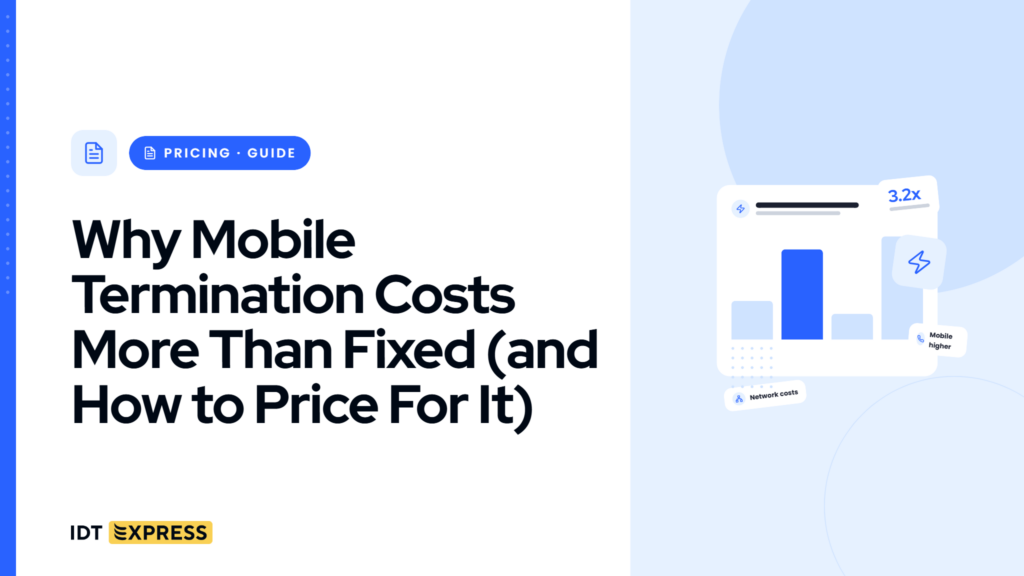
Calls to mobile numbers usually cost more to terminate than calls to fixed lines because the operator running the called mobile network charges a fee to complete each call, and in many countries those mobile termination fees are higher than fixed ones, particularly for calls arriving from abroad. Your carrier passes that fee through, plus its own margin. That’s why nearly every rate deck lists mobile and fixed prefixes separately for the same country.
The mechanics are simple. The pricing risk isn’t. I’ve seen more reseller margin lost to mobile-fixed mix shifts than to almost any other rate-deck issue, and nearly all of it came from a quote that looked reasonable when it was signed.
Why termination fees exist at all
In most of the world, the network of the person making the call pays the network of the person receiving it. This is the “calling party pays” model. The receiving operator charges a termination rate for completing the call to its subscriber.
Here’s the structural point that drives everything else: each operator is the only way to reach its own subscribers. If you want to call a number on a given mobile network, you pay that network’s rate, or you don’t complete the call. There’s no competing supplier for that last leg. Economists call it a termination monopoly, and it’s why regulators in many countries cap termination rates at all.
Fixed termination rates have generally been driven lower by regulation for longer, and fixed networks often have lower incremental costs per call. Mobile rates have come down in many markets too, but the gap persists in plenty of destinations. And regulation usually protects domestic calls first. International incoming calls are often where operators have the most freedom to charge more.
Origin-based pricing: where your call starts matters
Many destinations now price termination by where the call originated, not only by where it lands. For buyers, this is the part of the deck that most often surprises.
The clearest example is the European Union. Under a 2021 Commission delegated regulation, the EU set single maximum voice termination rates, one for mobile and one for fixed, across member states. Those caps apply to calls originating within the European Economic Area. Calls originating outside it can be charged differently, which is why many decks for EU destinations carry separate rates for EEA-origin and non-EEA-origin traffic, with the non-EEA rate often much higher.
Similar origin-based surcharges exist elsewhere, set by operators or regulators on international incoming traffic. The practical consequences for a buyer:
Your origination has to be classified correctly. Carriers typically determine origin from the calling number and the interconnect it arrives on. If you’re sending traffic that originates in several regions, expect to route or tag it so each call is priced on the right column.
Don’t try to game it. Presenting a local or EEA calling number on traffic that originated elsewhere to get a cheaper rate is exactly the behavior carriers and regulators look for. Expect disputes, back-billing, and in some places blocked calls. Our country playbook guide covers how CLI rules differ by destination.
Read surcharge notifications. Operators change international incoming rates, and carriers pass the change through with notice. If you’re not watching rate notifications per destination, you’ll find out on the invoice.
Prefixes, portability and the number that isn’t where it looks
Rate decks price by number prefix. Networks don’t always cooperate with that model.
Number portability lets subscribers keep their number when they switch operator, and in many countries between fixed and mobile services too. So a prefix that originally belonged to one network can now contain numbers served by others. Carriers handle this in different ways. Some route by looking up the current network for each number, then bill by prefix anyway. Some bill by the actual terminating network. Some do neither consistently.
What matters to you is how your carrier bills, because it decides whether a call to a ported number costs you the fixed or the mobile rate. Ask. Get the answer in writing. If you’re re-rating your CDRs to audit invoices (the billing increments guide explains why you should), prefix mismatches from portability are one of the common sources of disagreement.
Some numbering plans make the split harder still. In the North American Numbering Plan, for instance, mobile and fixed numbers generally aren’t distinguishable by prefix, so decks usually price US and Canadian destinations with a single rate rather than a mobile-fixed split.
Reading a split deck without missing the expensive rows
A split deck is only useful if you read it the way the carrier priced it. A few habits catch most of the costly surprises.
Start with the row structure. Many decks don’t stop at one mobile and one fixed line per country. They break mobile out by terminating operator, sometimes with a separate row per operator’s prefixes, and the spread between the cheapest and most expensive mobile operator in one country can be wide. If your traffic concentrates on one operator’s subscribers, the average mobile rate for that country tells you little.
Then find the columns that change the price without changing the row: origin (EEA and non-EEA, or similar), billing increments, and effective date. A rate with a future effective date is a price change you’ve already been notified about. Sort by it.
Last, check for special ranges. Premium-rate, shared-cost and satellite prefixes often sit in the same country block with rates far above the rest. They rarely appear in legitimate traffic, which is exactly why they’re worth blocking by default and allowing only on request.
The blended rate trap
A blended rate is one price per country that averages mobile and fixed. It’s easy to sell. It’s also a bet on your traffic mix, and the customer controls the mix.
An illustrative example. The rates are invented; the risk is not.
Suppose your buy rates to a destination are $0.004 per minute for fixed and $0.030 for mobile. You quote a customer a single rate assuming their traffic is 60% mobile:
- Your blended cost: (0.6 × $0.030) + (0.4 × $0.004) = $0.0196
- You quote $0.0220, expecting about $0.0024 margin per minute.
Now the customer’s traffic shifts to 90% mobile. That’s not unusual; it happens when a customer moves from calling businesses to calling consumers, or when fixed lines in the destination decline.
- Your new blended cost: (0.9 × $0.030) + (0.1 × $0.004) = $0.0274
- You’re still billing $0.0220. You lose about $0.0054 on every minute.
Nothing about your supplier changed. Nothing about your customer’s contract changed. Their behavior changed, and your quote made you carry the risk.
It gets worse when the shift is deliberate. Some buyers look for blended quotes precisely because they know their traffic is mobile-heavy. If your blended price is attractive, you’ll attract the traffic that makes it unprofitable.
How to quote customers without carrying their mix risk
There are three workable approaches, and I’d rank them in this order.
Quote split rates. Mobile and fixed priced separately, as your carrier prices them to you. It’s the most transparent option and it keeps the risk where it belongs. The objection is that customers find it complicated. Most carrier and CPaaS buyers don’t; they deal with split decks every day.
Quote blended with a mix clause. A single rate valid for a stated mix range, with an agreed repricing if the measured mix moves outside it. This works for customers who need one number for their own pricing, as long as you measure the mix monthly and actually enforce the clause.
Quote blended with a short validity period. A single rate that’s reviewed often. It’s the weakest protection, because you’re still exposed for the whole validity period, but it limits how long a bad mix can run.
What doesn’t work is a blended rate with no mix assumption written down. You’ve then signed a fixed-price contract on a variable cost. If you run tiered products, apply the same discipline per tier, since mobile share tends to differ by customer segment; see our guide to reselling voice termination in tiers.
What to ask your carrier
Before committing traffic, get clear answers on the parts of the deck that move:
- Which destinations price mobile and fixed separately, and which are blended?
- For which destinations does origin change the rate, and how do you classify origin?
- How do you bill ported numbers: by prefix or by actual network?
- How much notice do you give for rate changes, and how are notifications sent?
- How often is the prefix list updated, and how are new ranges communicated?
A carrier’s answers here tell you as much about the relationship as the rates do. Vague answers mean surprises later.
For buyers weighing carriers on coverage, it also helps to know how much of your destination list one supplier can handle. IDT Express terminates voice in 160+ countries across three quality tiers, which reduces the number of decks, notification streams and billing models you have to track, though you’ll still want the questions above answered for each of your major destinations. Our comparison of wholesale voice termination providers covers what else to weigh, and our explainer on what voice termination is and how it works explains the fundamentals.
Frequently asked questions
Why are calls to mobile phones more expensive than calls to landlines?
The mobile operator receiving the call charges a termination fee to complete it, and in many countries mobile termination fees are higher than fixed ones. Carriers pass those fees through in their rates, so mobile prefixes usually cost more.
What is a mobile termination rate?
A mobile termination rate is the fee a mobile operator charges other networks to complete a call to one of its subscribers. Each operator is the only route to its own subscribers, which is why many regulators cap these rates for domestic traffic.
Why do EU destinations have different rates for EEA and non-EEA traffic?
EU rules set maximum termination rates for calls that originate within the European Economic Area, while calls originating outside it can be charged differently. Rate decks often list separate EEA-origin and non-EEA-origin rates for that reason.
What is a blended rate in voice termination?
A blended rate is a single per-country price that averages the costs of mobile and fixed termination based on an assumed traffic mix. If the actual mix becomes more mobile-heavy than assumed, the seller’s cost rises while the price stays the same.
How does number portability affect termination costs?
When numbers move between operators or between fixed and mobile services, their prefix may no longer show which network serves them. Depending on how a carrier bills, a call to a ported number may be charged at a different rate than its prefix suggests.
Talk to our wholesale team
Planning pricing for mobile-heavy destinations? Talk to the IDT Express wholesale team about mobile, fixed and origin-based rates for your traffic.