It’s 9:40 on a Tuesday morning in Leeds. A finance manager has a billing question about a SaaS tool her team adopted last quarter. She opens the help page, finds a support number starting +1, and closes the tab. She’ll send an email instead, and she’ll mention the experience when the renewal comes up.
That’s the problem a local support line solves. You can give UK or German customers a local phone number without setting up a company in either country by provisioning DID numbers there and routing calls to wherever your support team sits. The catch is that countries set rules per number type. Some local numbers need a local address, others don’t, and picking the right type is most of the work.
This is written for SaaS and platform teams expanding into Europe who want the customer benefit of a local line before they have the legal footprint to match.
Why a local number changes how customers behave
A local number isn’t a vanity detail. It changes whether customers call at all, and how they feel when they do.
Think about what an international number asks of the caller. She has to wonder whether her desk phone allows international dialing. She has to wonder what it’ll cost. She may assume the support team works in a different time zone and won’t answer. Each doubt is small. Together, they push her toward the slower channel, and the slower channel is where frustration builds.
A local number removes every one of those doubts in the half-second it takes to read it. It also signals commitment. A company with a UK number looks like it intends to serve UK customers, even if the people answering sit in Lisbon or Manila.
There’s an outbound benefit too. When your team calls customers back, a local number is far more likely to be answered than an unfamiliar international one. If outbound callbacks are part of your support model, our guide to CLI and non-CLI routes explains why the number also has to survive the route intact.
The number types, and which ones need a local address
Most countries offer several kinds of numbers, and the rules differ by type. Choosing the type is the decision that determines whether you need a local address.
Geographic numbers belong to a city or area code, like 020 for London or 030 for Berlin. They look the most local, which is why teams want them. They also tend to carry the strictest address rules.
National or non-geographic numbers aren’t tied to one area but are still clearly domestic. In the UK, 03 numbers are the common choice for support lines; they’re charged to callers like a geographic call. In Germany, 032 numbers are national numbers without a link to one area code.
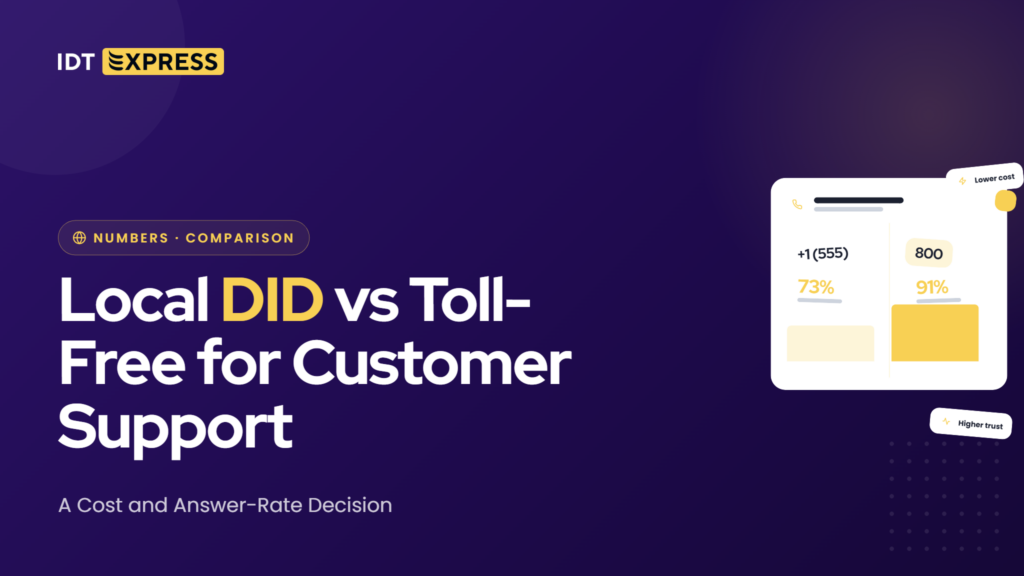
Toll-free numbers are free for the caller and paid for by you. They’re a different trade-off entirely, covered in our comparison of local DIDs and toll-free numbers for support.
Mobile numbers are rarely the right choice for a support line and are often restricted for this use.
Germany: the address rule is real
Germany is the classic example of a country where geographic numbers come with a location requirement. To hold a geographic number, you generally need a residence or business location within that area-code region. A Berlin number needs a Berlin address, not just a German one.
If you don’t have that, the national 032 range is the usual route for a foreign company that wants a German number without a German office. It reads as German, it doesn’t claim a city, and it doesn’t carry the local-presence requirement. For a support line, that’s often the better fit anyway, since your customers are nationwide.
The UK: easier, but still check
The UK has generally been more flexible for foreign businesses, and 03 numbers are a widely used, customer-friendly option that avoids tying the line to a city. Requirements for geographic numbers can depend on your provider and on current regulatory expectations, so confirm before you commit. The safest assumption is that you’ll be asked to provide business details and a valid address of some kind, and that the provider will keep them on file.
The broader lesson applies to every country on your roadmap: find out which number types need which documents before you design the support experience around a specific type. Our DID regulatory requirements checklist covers how to collect and manage that paperwork.
Designing the line around the customer, not the number
Getting the number is the easy half. What happens after the caller dials it is where the customer experience is won or lost.
Answer in their hours
A UK number that rings out at 10 a.m. London time is worse than no number at all. It confirms the suspicion the local number was meant to dispel. Map your support hours to the customer’s business day, not yours. If you can’t staff those hours yet, route out-of-hours calls to a clear message with the hours you do answer and an alternative channel, not to a voicemail box nobody checks.
Speak their language from the first second
German customers dialing a German number expect German. Put the IVR greeting in the local language, and if your agents can’t all speak it, say so plainly and offer English, rather than pretending otherwise. Customers forgive a language limitation they were told about. They don’t forgive a surprise.
Keep the menu short
A local number sets the expectation of a local, human experience. A five-level IVR undoes that. One or two choices, then a person. If you’re routing by product or plan, use the caller’s number to look up the account and skip the menu entirely where you can.
Show the number where the problem happens
The number helps only if customers find it at the moment of need. Put it on the billing page, in invoice emails, and in the in-app help panel for customers in that country. Geo-targeting the number on your help center is simple and it’s where most of the benefit lives.
Routing: where the call goes after it lands
Once the number is provisioned, the call reaches your system over the carrier’s network and is delivered to wherever your support stack lives: a contact center platform, a cloud PBX, or your own SIP infrastructure.
A few decisions matter here:
- Delivery method. Most support platforms accept inbound calls over SIP. You’ll point the DID at a SIP endpoint the platform gives you, or at your own SBC.
- Failover. Decide what happens if the primary destination is unreachable. A secondary SIP destination, or forwarding to a backup number, keeps the line answering during an outage.
- Caller ID passthrough. Make sure the caller’s number reaches your agents so they can look up the account. This depends on both the carrier and your platform’s configuration.
- Recording and data location. If you record calls, know where recordings are stored and what your customers’ data expectations are. That’s an operational and legal question to settle with your own counsel, not something the number decides for you.
If you already have a number in another provider’s network, porting it in may be simpler than starting fresh; our guide to porting numbers with LOA and FOC covers what that involves.
One provider or one per country?
Once the UK line works, the next request is usually Germany, then France, then the Netherlands. Every new country is a new set of number types, rules, documents and routing. Doing this with a different provider per country multiplies the integrations and the paperwork.
That’s where coverage matters. IDT Express provides DID numbers in 140+ countries, so a SaaS team can add markets through one relationship and one routing setup rather than rebuilding for each country. Whichever provider you use, ask for the number types available in each country and the documents each type needs, before your product team promises a launch date.
For pricing by country, see the DID numbers pricing page. For the fundamentals of how DIDs work, start with our guide to what a DID number is.
A launch checklist for a new country
Before a local support line goes live, run through this:
- Pick the number type that fits your footprint: geographic if you have a local address, national or non-geographic if you don’t.
- Confirm the documents that type needs and gather them.
- Provision the number and point it at your support platform.
- Configure failover to a second destination.
- Record a local-language greeting and a short menu.
- Set hours in the customer’s time zone and an out-of-hours message.
- Place test calls from local landlines and mobiles, checking audio and caller ID.
- Publish the number where customers in that country look for help.
It’s a day or two of work for most teams, once the paperwork is in hand. The paperwork is usually the long pole.
What to measure after launch
A local line is an experiment until the data says otherwise. Track inbound call volume from the new market against the weeks before launch, the share of those customers who switched from email or chat to phone, and time to answer during local business hours. Watch abandonment in the first seconds of the IVR, since it usually points to a greeting or menu that doesn’t fit the market. If call volume barely moves, check that the number is visible where customers look for help before concluding that the market doesn’t want phone support.
Frequently asked questions
Can a foreign company get a UK phone number?
Yes. Foreign businesses can usually get UK numbers through a provider that offers them, and non-geographic 03 numbers are a common choice for support lines. Expect to provide business details and an address, and confirm the current requirements for the specific number type.
Do you need a German address to get a German phone number?
For German geographic numbers, you generally need a residence or business location in that area-code region. National 032 numbers don’t carry that requirement, which makes them the usual option for foreign companies without a German office.
What is the difference between a geographic and a non-geographic number?
A geographic number is tied to a specific city or area code, while a non-geographic number is national and not linked to one place. Geographic numbers often have stricter address rules.
Can I route a local number to a support team in another country?
Yes. A DID number can deliver calls over SIP to a contact center platform or PBX anywhere, so the number can be local while the team answering is elsewhere.
Is a local number better than a toll-free number for customer support?
It depends on who’s calling and from where. Local numbers are cheaper to run and look more personal, while toll-free numbers remove call costs for the caller but can be less reachable from some mobile networks abroad.
Talk to our numbers team
Planning local support lines in new markets? Talk to the IDT Express numbers team about number types and requirements in the countries on your roadmap.